How can pharmacies spot temperature excursions when refrigerated medicines are delivered to patients at home? This guide explains how Holtronic’s single-use and reusable neo® indicators flag exposure outside 2–8°C, including below 0°C, and how downloadable reports can help pharmacy teams investigate alerts.
Home sample collection puts part of the transport process outside the laboratory’s direct control. A specimen might wait in the patient’s home before posting, sit in a collection point or travel through several depots. Weekend delays can extend the journey. Seasonal weather can change the conditions a parcel experiences even when the route and delivery time are familiar.
Packaging, preservatives and return instructions control different parts of that risk. Insulation slows temperature changes. A stabilising medium can help preserve a particular analyte. A temperature indicator adds evidence from the individual parcel. That evidence can help a laboratory investigate excursions, apply its specimen acceptance procedure and see whether issues cluster around particular routes, seasons or packaging formats.
The return journey usually matters most when the patient is sending a collected specimen to a laboratory. There can also be a case for monitoring outbound kits if they contain temperature-sensitive reagents or collection materials. Each leg has its own requirements and activation point.
| Specimen or kit | What to assess before choosing a monitor |
|---|---|
| Finger-prick blood collected into a tube | The stability of the specific analytes, the tube and additives, the allowable time to processing and sensitivity to heat or freezing. |
| Dried blood spot cards | The assay’s stability limits, the drying and moisture-control requirements and whether the return route presents a meaningful heat risk. |
| Stool and microbiome samples | Which biomarkers or organisms are being measured, whether a preservative is used and the validated return conditions for each container. |
| Urine samples | Whether the test is a culture or another analysis, which container or preservative is specified and the allowed storage and transit conditions. |
| Saliva and self-collected swabs | Whether the collection medium stabilises the target, the permitted transit window and whether likely heat or cold exposure could exceed the validated limits. |
A home blood test can use liquid capillary blood collected into a small tube or blood dried on a collection card. Each format has its own handling requirements. For a liquid sample, a laboratory may want to flag excessive heat or accidental freezing where its stability evidence shows that either exposure matters. For a dried blood spot, the return workflow may depend on the card being fully dry before packing and on moisture control, with heat monitoring added where the assay and route justify it.
For example, Cambridge University Hospitals’ dried blood spot instructions call for the dry card to be placed in the specimen bag and posted in the supplied envelope. The CDC’s guidance for a specific cold-shipment workflow also addresses drying, humidity control and heat exposure. A monitor covers the temperature component of that workflow, while the kit’s packaging and instructions address drying and moisture. Cambridge University Hospitals guidance · CDC dried blood spot shipping guidance
A stool collection kit may contain multiple containers intended for different analyses. A preserved swab for one test can have a different transport profile from a stool sample collected for gastrointestinal biomarker testing. The monitoring plan should reflect the specific container and test that need temperature evidence.
In one home stool collection workflow, the patient activates a compact temperature indicator as part of packing the sample for return. The laboratory can check the indicator when the package arrives and use the result alongside the kit’s validated return window and specimen acceptance criteria. This approach gives patients a single activation step and gives the laboratory temperature evidence tied to the individual return pack.
For postal urine testing, the receiving lab’s instructions depend on the analysis and container. Urine culture guidance, for example, can specify a preservative or call for refrigeration under certain conditions if transport is delayed. For saliva or self-collected swabs, the useful question is whether the actual return journey could exceed the validated limits of the assay and its collection medium. Berkshire and Surrey Pathology Services urine culture guidance · University Hospitals Sussex specimen guidance
A temperature threshold defines when an excursion starts. A time limit defines how much exposure triggers an alarm. With a time–temperature indicator, the laboratory can select an alarm rule that reflects how the specimen responds to exposure.
Imagine a kit with an illustrative upper limit of 25°C for 30 cumulative minutes. The parcel spends 12 minutes above 25°C while waiting for collection and another 20 minutes above 25°C at a depot. That is 32 minutes of exposure above the limit, enough to trigger the cumulative alarm. An alarm set for one continuous 30-minute event would remain clear for those same two excursions. The example explains the two settings. The laboratory’s stability data determine which thresholds and durations belong in a real kit.
This is how neo® integrates time and temperature into an actionable alarm. Each configured threshold has its own rule, so the device can flag a shorter exposure at one threshold and a longer exposure at another.
Small enough for a compact return pack. The neo® Penta is 24.6 × 44.5 × 5.8 mm and weighs 6 g. Its slim form makes it practical to position near a specimen pouch inside a small postal kit. During validation, check the indicator in its intended position and assess how its readings relate to the specimen under realistic transport conditions. neo® Penta specifications
Accurate where decisions are made. Holtronic specifies ±0.5°C accuracy at 0°C, 2°C and 8°C for the published neo® Penta example. The value of that precision is clearest when a receiving procedure depends on a specific alarm point. For custom thresholds, confirm the applicable accuracy and decide how the laboratory will handle readings close to its acceptance limits. neo® Penta specifications
Simple instructions for patients. Kit providers can include a short illustrated instruction beside the return-packing step. Show which button to press, when to press and hold it, which LED signal confirms activation and where the indicator goes in the pack. The patient can complete the step using the device and the instructions supplied in the kit. Holtronic single-use temperature indicators
A quick visual check at laboratory intake. Receiving staff can read the LEDs as they unpack the specimen. A triggered alarm remains visible even if the parcel returns to its expected temperature range. Staff can use the alarm status alongside transit time and other specimen acceptance checks to decide whether to proceed with testing or review the sample. Holtronic single-use temperature indicators
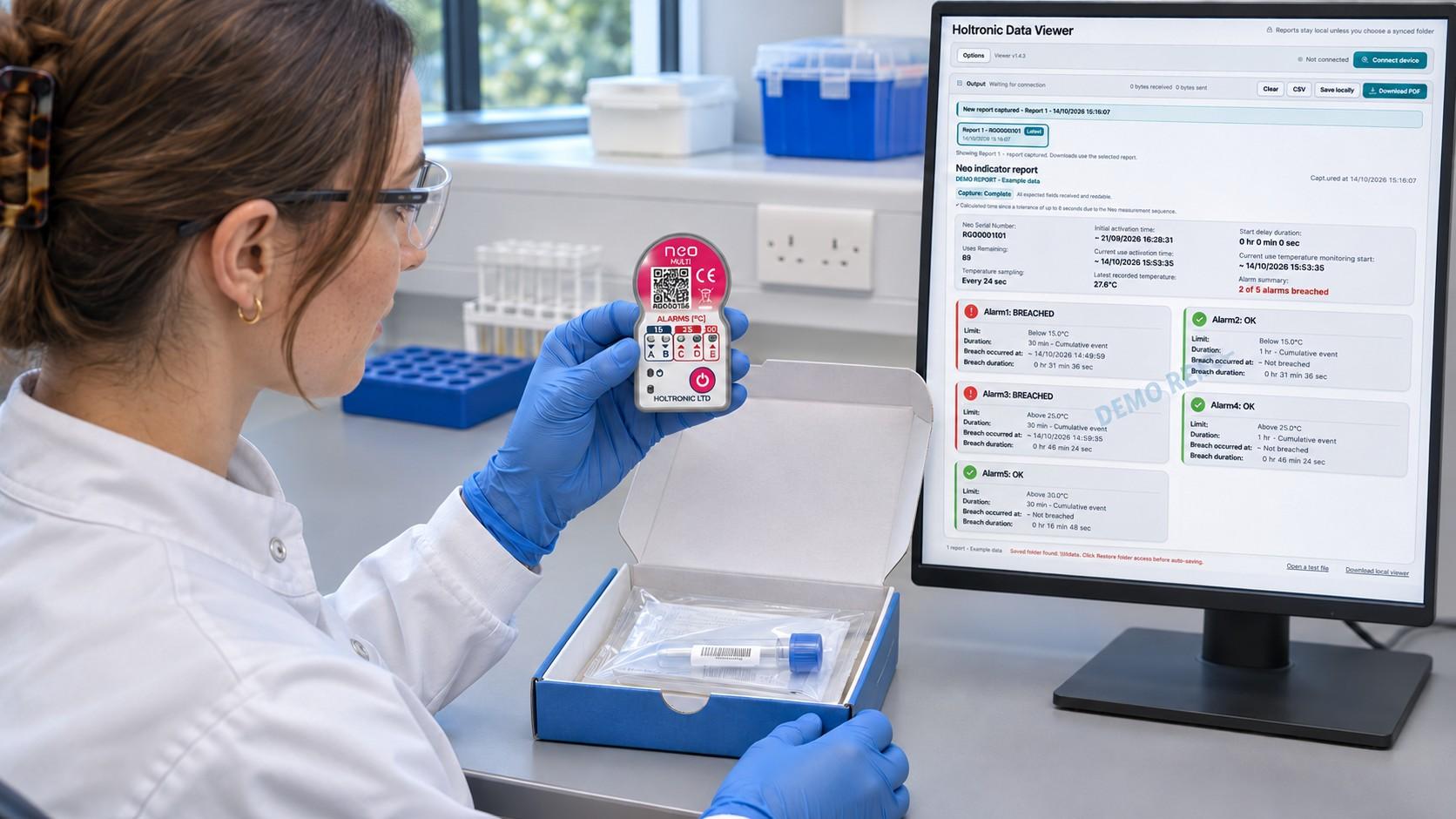
Download a PDF or CSV for the specimen record. For a download-enabled neo® indicator, staff connect the device using Holtronic’s Data Download Dongle and open the browser viewer. Depending on the configuration, the report can show the device serial number, temperature thresholds, exposure rules and recorded breach timing. Staff can save a PDF with the specimen or quality record, or export a CSV to compare data across shipments. The LED check supports the immediate intake decision, and the saved report gives the lab more detail for follow-up or audit. Holtronic Data Download Dongle viewer
Cost-effective for routine one-way returns. A single-use indicator avoids a return loop for the device, and a visual check can reduce the time spent downloading and reviewing data for every parcel. A cost comparison should include the device, staff time at intake and the cost of avoidable repeat collections. This is especially relevant when most parcels need a straightforward check and only flagged shipments require further investigation.
Reusable monitoring where indicators can be recovered. Holtronic’s neo® Multi-X is a reusable temperature indicator that can be reset with the neo® Reset Jig and used again for up to 90 monitoring cycles. It can suit programmes where the laboratory can retrieve the device from returned kits and put it back into circulation. Reuse can reduce the number of indicators discarded and lower the device cost per shipment. The overall savings depend on how often devices are recovered and the time needed to check, reset and redeploy them. neo® Multi-X reusable temperature indicators
Take a postal stool kit with a validated upper temperature limit and a cumulative exposure allowance. The patient follows the illustrated packing instructions, presses and holds the button, and checks for the activation signal before sealing the return pack.
When the sample arrives, intake staff check the indicator’s activation status and look for an alarm. If the device is active and shows no alarm, staff can continue with their usual checks on transit time, labelling and specimen condition. If an alarm has triggered, they can flag the sample for review and use the Data Download Dongle to save a PDF with the available breach details. The laboratory uses that evidence, together with its acceptance criteria, to decide whether to test the sample or request a replacement. If the team sees a pattern across multiple returns, CSV exports can help it investigate whether particular routes or packaging are associated with more alarms.
A temperature indicator travels inside the return pack with the specimen and flags exposure that meets a configured alarm rule. Receiving staff check its LEDs at intake and can download the available alarm details from a compatible indicator.
The required conditions depend on the assay, collection tube or card and the test provider’s validated instructions. Patients should follow the instructions supplied with their kit. Laboratories should set monitor thresholds using stability evidence for that specific specimen and test.
Yes. A suitably configured indicator can flag when the temperature at its sensor goes below a chosen threshold for a defined period. The laboratory can use that evidence alongside its validation data to assess whether the specimen may have been affected.
Place it where validation shows that the sensor gives a representative reading of conditions near the specimen. Consider proximity to the sample pouch, insulation and any cooling materials. Keep the indicator separate from direct contact with the specimen.
Yes. With a download-enabled neo® indicator and the Data Download Dongle, staff can check the LEDs on arrival and save a PDF report for the specimen record or export a CSV for analysis. The report contains the alarm details available from that device.
A clear indicator means the device recorded no configured alarm after activation. The laboratory makes its acceptance decision using its full criteria, including transit time, sample condition, collection requirements and any applicable temperature evidence.
Holtronic can discuss custom neo® configurations for upper and lower thresholds, alarm durations, and single-event or cumulative exposure. Share your specimen format, stability limits, return packaging and expected volumes so we can help identify a configuration that fits your workflow.
If you’re designing a postal diagnostic kit or reviewing an existing sample return service, tell us what the specimen needs to withstand and what your laboratory needs to see when it arrives. We can help you specify a compact neo® indicator for your validated transport conditions. Contact Holtronic
