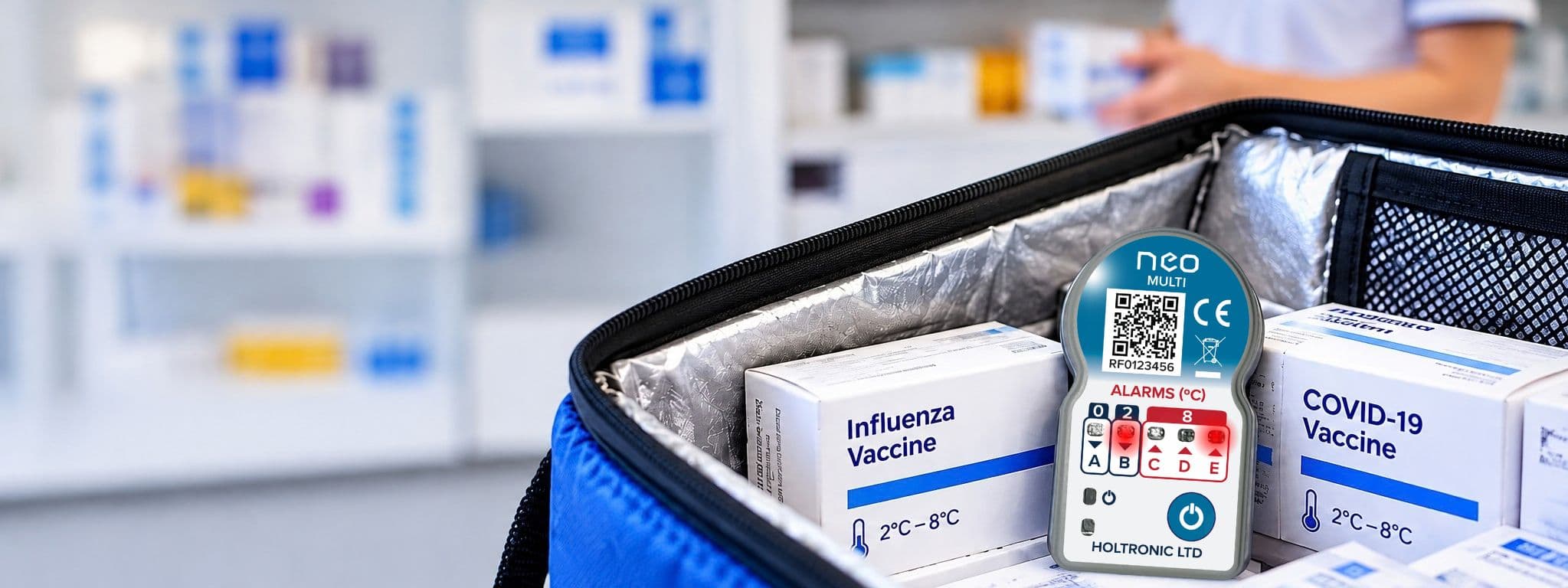
Practical guidance on monitoring vaccine temperatures during transport, including cold bags, 2–8°C monitoring and reusable electronic temperature monitors.
Vaccines don’t always stay in the fridge.
They may need to travel from a pharmacy to a vaccination clinic, between healthcare facilities, into the community, to a care home, to schools for vaccination programmes, or directly to a patient.
Once vaccines leave controlled refrigerated storage, healthcare teams need a practical way to monitor the temperature conditions they experience during transport.
For many refrigerated vaccines and medicines, this means monitoring against defined temperature requirements such as 2°C to 8°C, although the approved storage and excursion limits for the individual vaccine must always be followed.
The challenge is not simply collecting temperature data. It is making that information useful to the person handling the vaccines.
Have the vaccines remained within the required temperature conditions, or do they need to be checked before use?
Modern electronic temperature monitoring can provide an immediate visual answer while retaining more detailed temperature evidence when it is required.
Vaccine temperature monitoring during transport involves placing a suitable temperature monitoring device with the vaccines, typically inside the cold bag or transport container, so that it monitors the conditions experienced during the journey.
The appropriate monitoring method depends on the vaccine, permitted temperature excursions, journey duration, cold bag or packaging system and the organisation’s procedures.
For repeated vaccine movements, an electronic temperature monitor can provide a simple visual status at the destination while retaining data for further investigation if an alarm occurs.
This is different from relying only on the temperature of the refrigerator before the vaccines leave.
Once vaccines are in transit, the monitor needs to provide information about the conditions experienced during that journey.
A controlled pharmacy or medical refrigerator is designed to maintain defined storage conditions.
Transport introduces additional variables.
A cold bag or transport container may be opened. A journey may take longer than expected. Cooling materials may warm over time. External temperatures can change. Equally, placing temperature-sensitive products too close to frozen cooling materials may expose them to excessively low temperatures.
Monitoring the vaccine during transport provides information about what happened between leaving controlled storage and reaching the point of use.
That could be a hospital department, community vaccination clinic, care home, school vaccination programme or another healthcare setting.
This can help healthcare teams identify potential temperature excursions and determine when further assessment is required.
A vaccine temperature excursion occurs when a vaccine is exposed to conditions outside its specified temperature requirements.
However, an excursion should not automatically be interpreted as meaning that a vaccine is unusable.
The significance of an excursion can depend on factors including the vaccine, temperature reached and duration of exposure.
A temperature monitoring device therefore provides evidence of the temperature conditions. Decisions about the suitability of a particular vaccine following an excursion should be made according to the manufacturer’s stability information and the organisation’s applicable procedures.
Many refrigerated pharmaceutical products are handled within a 2°C to 8°C cold chain.
Temperature monitoring during transport can be configured around defined limits and alarm conditions appropriate to the particular application.
Importantly, an alarm does not always have to mean that the temperature briefly crossed a single threshold.
Electronic monitors can be configured to consider factors such as temperature and time, allowing monitoring requirements to better reflect a defined temperature-excursion policy.
The exact alarm configuration should always be established for the product and application being monitored.
Traditional data loggers are useful when a complete temperature record needs to be analysed.
However, that isn’t necessarily what the person receiving the vaccines needs at the point of delivery.
A nurse receiving a cold bag containing vaccines at a school vaccination programme, for example, may first need a straightforward answer:
Are the monitored temperature conditions acceptable, or does this cold bag need to be checked?
An electronic temperature indicator can make that information immediately visible while retaining additional information for the pharmacy or quality team.
This is the approach behind Holtronic’s neo® electronic temperature monitoring range.
Rather than requiring the user to connect the device to a computer before knowing its status, neo® uses clear LED indications to communicate the monitoring result directly from the device.
Where more detailed evidence is required, temperature information can be downloaded for further review.
The aim is not to replace detailed temperature data where it is required. It is to make routine temperature monitoring easier for the people who actually handle the vaccines.
A neo® electronic temperature monitor travels inside the cold bag or transport container with the vaccines during the journey and monitors against its programmed temperature and time conditions.
The device can be configured around the requirements of a particular application rather than relying on one universal alarm setting.
At the destination, the user checks the LEDs on the device.
If the programmed monitoring conditions remain acceptable, the appropriate status is displayed.
If a defined alarm condition has been reached, the device provides a visual indication that the vaccines require further checking.
This can be particularly useful where vaccines are moving between a central pharmacy and locations such as community clinics, care homes, schools or other healthcare facilities.
The person receiving the vaccines gets an immediate visual indication, while the pharmacy or quality team can access additional evidence when required.
Temperature assurance at a glance, with the evidence to back it up.
No. Different applications require different levels of information.
A traditional temperature data logger can provide detailed temperature records, which can be valuable when a full dataset needs to be reviewed.
But the person receiving vaccines may not need to analyse a graph every time a cold bag arrives.
Their immediate question may simply be:
Are the monitored temperature conditions acceptable, or does this delivery require further investigation?
An electronic temperature indicator can make that first assessment easier by providing a clear visual status.
Detailed temperature information can then be available when it is actually needed.
Visual indication can be particularly useful when vaccines are being handled by different people at different stages of a journey.
Holtronic neo® devices use LED indications so that temperature status can be checked directly from the monitor.
This can reduce the need for every person receiving vaccines to understand temperature graphs or operate data-logging software.
It also separates two different requirements:
At the point of use: provide a clear and easily understood indication.
When further investigation is required: provide additional temperature evidence.
For routine movements, the visual indication may be all that is needed at the destination.
If an alarm occurs, the organisation can then follow its established excursion procedure.
Yes. A visual indication and a temperature report serve different purposes.
The LED indication is designed to give the person handling the vaccines a quick indication of status.
A downloadable temperature report can provide additional evidence when more detailed information is required.
For example, if a temperature alarm occurs, a pharmacy or quality team may want to investigate the conditions experienced during the journey.
This combination means users don’t necessarily need to download and analyse data following every routine journey, while supporting more detailed investigation when required.
Some electronic temperature monitors can be reused, depending on their design and intended application.
Reusable monitoring can be particularly useful where vaccines regularly travel in cold bags from a central pharmacy to clinics, community healthcare teams, care homes or schools and the monitoring device is subsequently returned.
Instead of disposing of a logger after every journey, the same device can be securely reset and used again within its specified operating life.
Holtronic’s neo® RF reusable temperature monitor is designed for this type of repeated temperature-monitoring application.
It can provide up to 90 uses within 90 days, subject to the configured application and operating conditions.
This makes reusable monitoring particularly relevant when an organisation has a regular, repeatable transport route and can return the monitor after each use.
The potential advantage becomes clearer when an organisation carries out repeated vaccine movements.
Consider a pharmacy regularly preparing vaccine cold bags for community clinics or school vaccination programmes.
If a new single-use logger is required for every journey, each movement requires another device.
A reusable electronic monitor allows the same device to be used across multiple journeys within its defined operating period.
This can reduce both the cost per monitored journey and the number of monitoring devices being discarded.
However, reusability also needs to be controlled.
A monitor should not simply be reset without an appropriate process, particularly following an alarm.
Holtronic neo® reusable temperature monitors use a controlled reset process.
This means the monitoring cycle can be reset between journeys by the appropriate team rather than simply clearing an alarm without control.
A typical workflow could be:
The monitoring process can therefore become part of the normal vaccine transport workflow.
A temperature data logger primarily records temperature measurements so that the resulting data can be downloaded and analysed.
A temperature indicator is designed primarily to make the result of monitoring easy to interpret, for example through an LED alarm or status indication.
Electronic technology allows these functions to overlap.
A device such as neo® can provide a simple visual indication for routine use while also retaining information that can be downloaded when additional evidence is needed.
The appropriate choice therefore depends less on the name of the device and more on what the organisation needs users to do with the information.
Neither approach is automatically better. They suit different types of vaccine movement.
Single-use monitoring can make sense when the vaccine is being shipped to a destination and the temperature monitor will not return.
Reusable monitoring may be more appropriate where vaccines regularly leave a central pharmacy in a cold bag or transport container and the monitor can be returned after each journey.
Examples could include regular movements to community vaccination clinics, healthcare facilities, care homes and schools.
Understanding the journey is therefore an important part of choosing the monitoring method.
When evaluating a solution, consider the complete vaccine journey rather than simply comparing logger specifications.
Useful questions include:
The answers help determine whether a single-use temperature indicator, reusable electronic temperature monitor or conventional data logger is appropriate.
The required transport temperature depends on the specific vaccine and its approved storage conditions. Many refrigerated vaccines are handled within a 2°C to 8°C cold chain, but the manufacturer’s requirements for the individual vaccine should always be followed.
A suitable temperature monitoring device can travel inside the cold bag or transport container with the vaccines and monitor the temperature conditions experienced during the journey.
Depending on the device, the result may be shown visually, recorded for later download, or both.
Vaccines used in school vaccination programmes may need to be transported from their normal controlled storage location to the school or vaccination location.
The applicable vaccine storage requirements and local procedures should determine how the cold chain is maintained and monitored during that journey.
A portable temperature monitor can travel inside the cold bag with the vaccines and provide evidence of the conditions experienced during transport.
An alarm indicates that the programmed alarm condition has been reached.
It does not by itself determine whether the vaccine must be discarded.
The excursion should be assessed using the relevant vaccine stability information and the organisation’s procedures.
Electronic temperature monitoring devices can provide downloadable information in addition to visual alarms.
This can allow the person receiving the vaccines to check the status immediately while giving pharmacy or quality teams access to more detailed information when required.
Yes.
Reusable electronic temperature monitors can be appropriate for repeated vaccine movements where the device returns to the organisation after each journey.
This can include vaccine movements between a central pharmacy and clinics, schools, care homes or other healthcare locations.
Holtronic neo® RF is a reusable electronic temperature monitor designed for repeated temperature-controlled movements of medicines and vaccines.
It provides clear LED status indications so users can check the monitoring result at a glance, with downloadable temperature information available when additional evidence is required.
For applications involving repeated journeys, neo® RF can be securely reset and used for up to 90 uses within 90 days, subject to the configured application and operating conditions.
A compact temperature monitor can travel inside the cold bag or transport container with the vaccines, allowing the conditions experienced during that particular movement to be monitored.
The monitoring process and device placement should form part of the organisation’s defined transport procedure.
Good temperature monitoring should provide the right information to the right person.
A nurse receiving vaccines at a clinic or school may primarily need to know whether the defined monitoring conditions have been maintained.
A pharmacist or quality professional investigating an excursion may need more detailed evidence.
A healthcare organisation carrying out hundreds of repeat journeys may also need to consider the cost and waste created by using a new logger for every movement.
Combining visual temperature indication, downloadable reporting, device traceability and reusable monitoring can help address these different requirements within one monitoring process.
The important point is that the monitoring method should fit the vaccine journey, rather than forcing every journey into the same monitoring process.
Holtronic designs electronic temperature monitoring solutions for pharmaceutical, healthcare and cold-chain applications.
The neo® range includes single-use and reusable electronic temperature monitors that can be configured for specific temperature and time requirements.
For repeated vaccine transport applications, neo® RF combines visual LED temperature status with downloadable reporting and controlled reuse, providing up to 90 uses within 90 days.
For one-way vaccine or pharmaceutical movements, single-use electronic monitoring may be more appropriate.
The choice depends on the product, temperature requirements, journey and how the monitoring information will be used.
If you are reviewing how vaccines move from controlled storage in cold bags or transport containers to clinics, community healthcare teams, care homes, schools or patients, Holtronic can help you explore an appropriate monitoring configuration for the journey.
Contact Holtronic to discuss your vaccine temperature monitoring requirements.